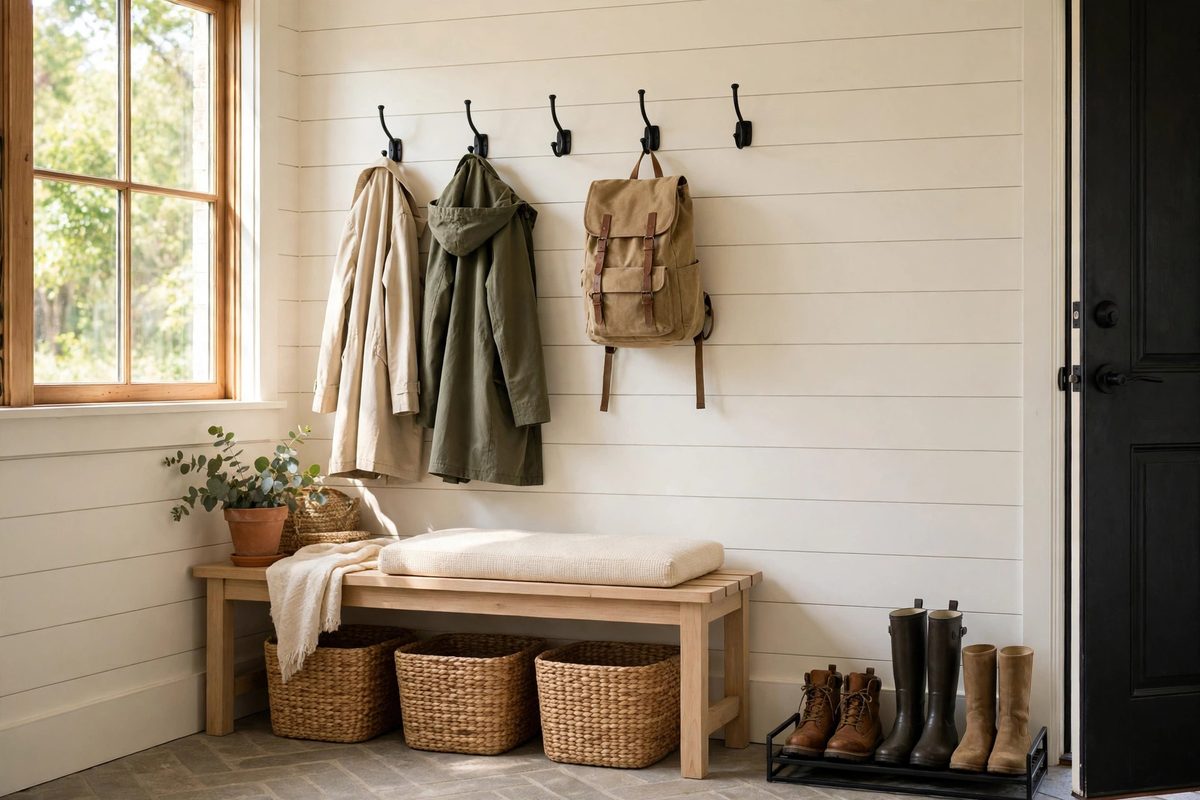
Every home has a spot where the outside world lands. Coats come off, boots get kicked aside, bags drop, keys vanish, and the dog leash ends up somewhere new each day. In homes with a mudroom, that spot is a room with a purpose. In homes without one, it is a pile by the door that grows a little every week. Either way, the fix is the same. The mudroom needs a home for each thing that arrives, and each person who arrives, so nothing has to be stacked, hunted, or stepped over.
A mudroom is not an entryway, though the two are cousins. An entryway is a passage, a few hooks and a rug in a hallway. A mudroom is a working room, or a working zone, with a bench, storage, and a system that survives wet boots and school mornings. This guide covers mudroom organization ideas that fit real homes, from a full built-in mudroom to a hallway nook with a bench and a row of hooks, with storage choices, budget fixes, and a seasonal rotation that keeps the room working through winter.
Table of Contents
- Start with a mudroom edit
- Zone it by person, not by pile
- The bench does the heavy lifting
- Hooks and coat storage that actually holds
- Boot trays and a drying zone for wet gear
- One basket per person
- Backpacks, bags, and sports gear
- Small mudrooms and hallway nooks
- Budget mudroom organization
- The seasonal rotation and mistakes to avoid
- Frequently asked questions
Start with a mudroom edit
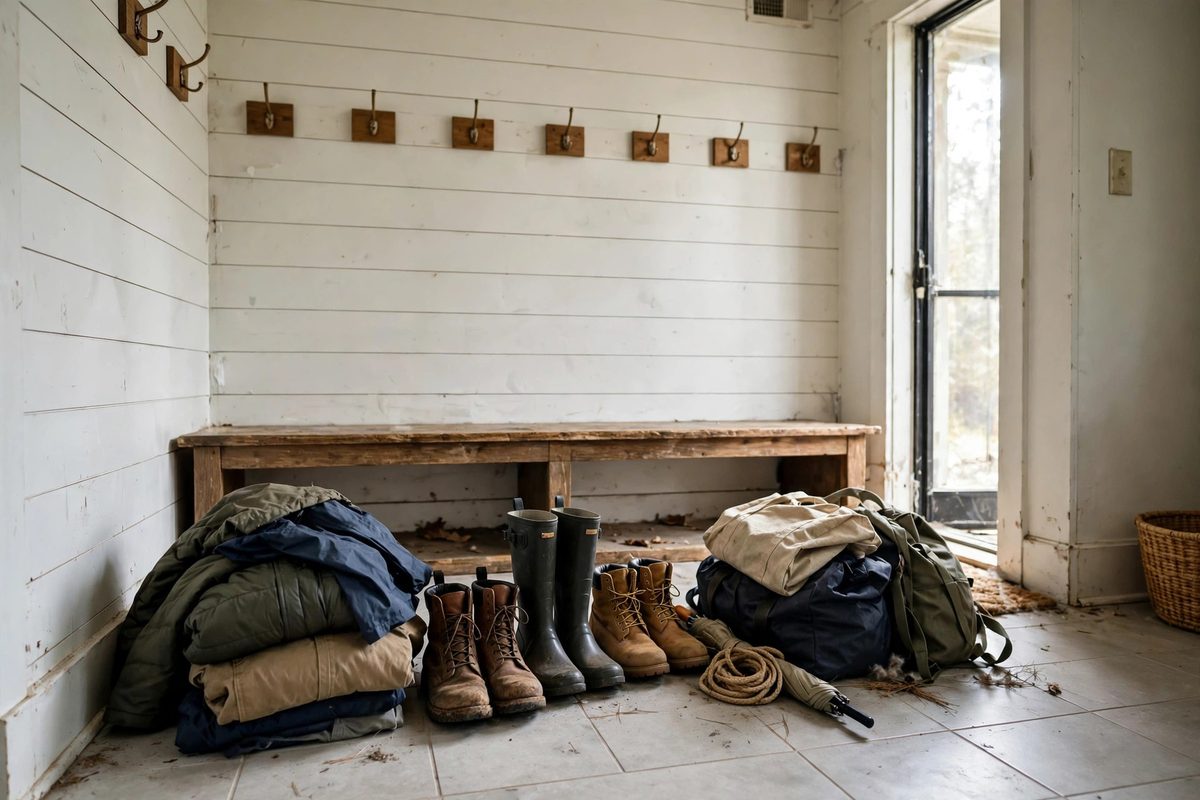
Before you buy hooks or baskets, empty the mudroom completely and look at what actually lives there. Not the mudroom you imagine, the one you have. You will find coats nobody wears, boots that no longer fit, single gloves, bags from last season, sports gear for a sport that ended in spring, and at least one thing that belongs in a completely different room.
Sort into four groups: keep and use now, keep but store elsewhere until its season, donate or pass on, and throw away or recycle. Be honest about the middle group. A coat that has not been worn in two winters does not need a hook, it needs a new home. The same sort-first rule runs through our guide to Entryway Organization Ideas, and it matters even more in a mudroom, because a mudroom can hold a whole season of gear and still look full if nothing actually leaves.
Zone it by person, not by pile
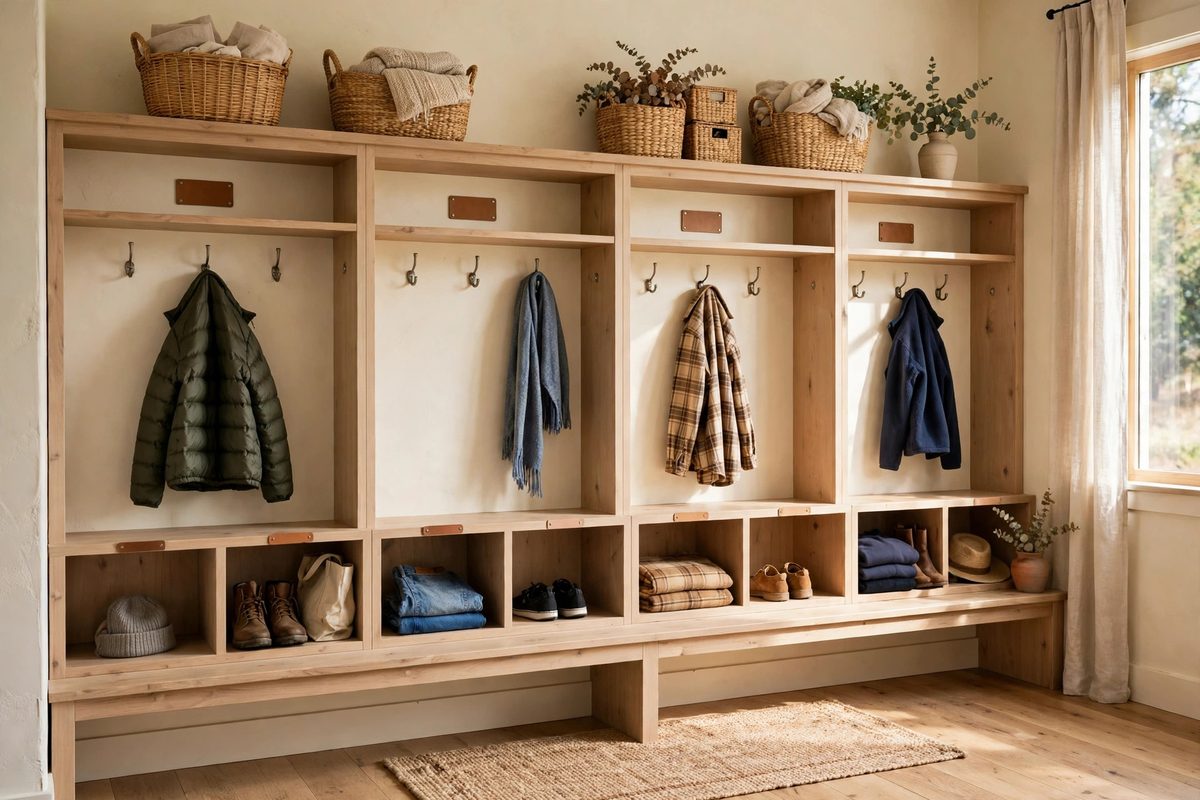
A mudroom works when each person has a spot and the spots do not bleed into each other. One shared pile of coats becomes a tangle within a week. Four small zones, one per person, stay usable because everyone knows exactly where their things belong.
Give each person a hook or two, a cubby or basket, and a shoe spot. Children get lower hooks they can actually reach, so coats go on the hook instead of on the floor beside it. Adults get one hook for the daily coat and one for a bag, not five hooks that invite overflow. Label each zone with a name tag, a color, or a small photo for younger kids. When the zones are personal, the mudroom stops being a communal dumping ground and starts being four small systems that each take care of themselves. The same zone thinking helped the tight hallway in our entryway guide, and it works just as well across a full mudroom wall.
The bench does the heavy lifting
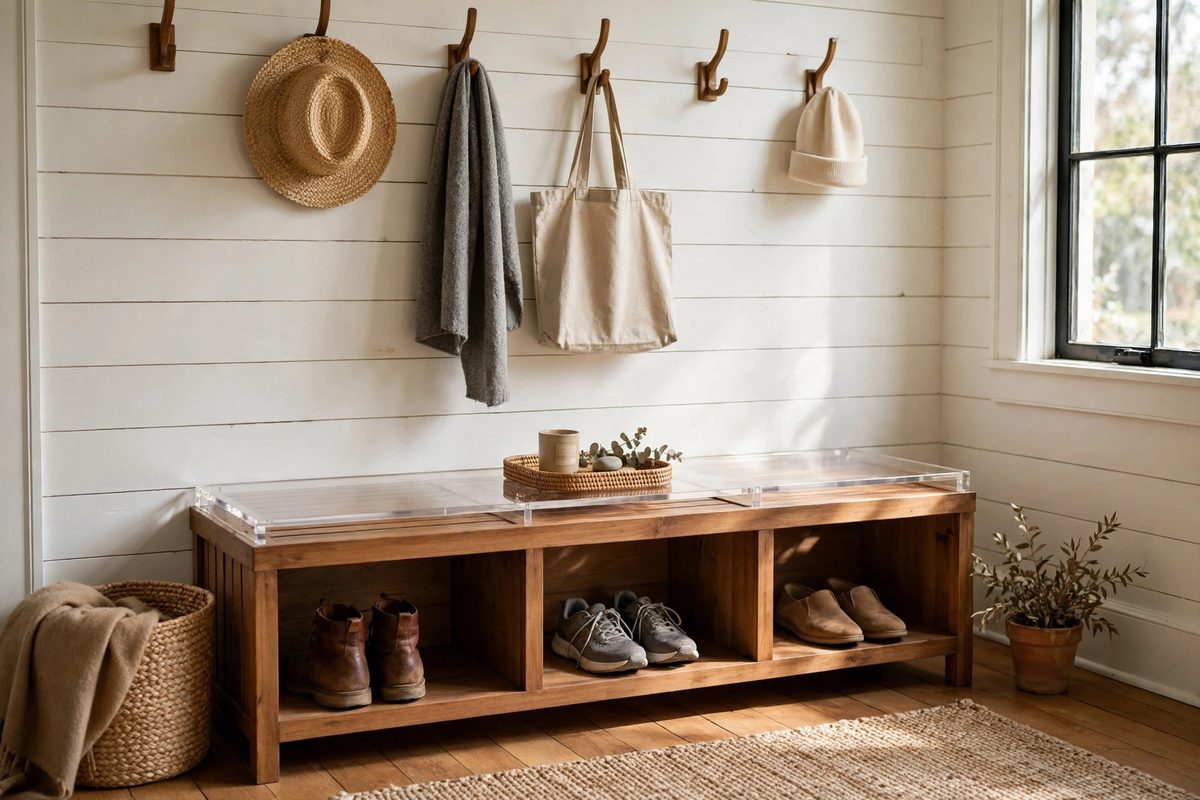
A bench is the one piece of furniture that earns its place in every mudroom. It is where you sit to pull on boots, where bags land when hands are full, and where the room gets its shape. Without a bench, the mudroom is just a wall of hooks and a floor full of shoes.
Choose a bench with storage built in, not a bare seat. Open cubbies underneath hold shoes in pairs, one pair per cubby, so the floor stays clear. A bench with a lift-up lid hides gloves, hats, and scarves in one deep compartment. Leave the top surface mostly clear. A bench covered in mail and shopping bags cannot do its job. One small tray on the bench for keys and sunglasses is enough. Everything else belongs in a cubby or a basket, not on the seat.
Hooks and coat storage that actually holds
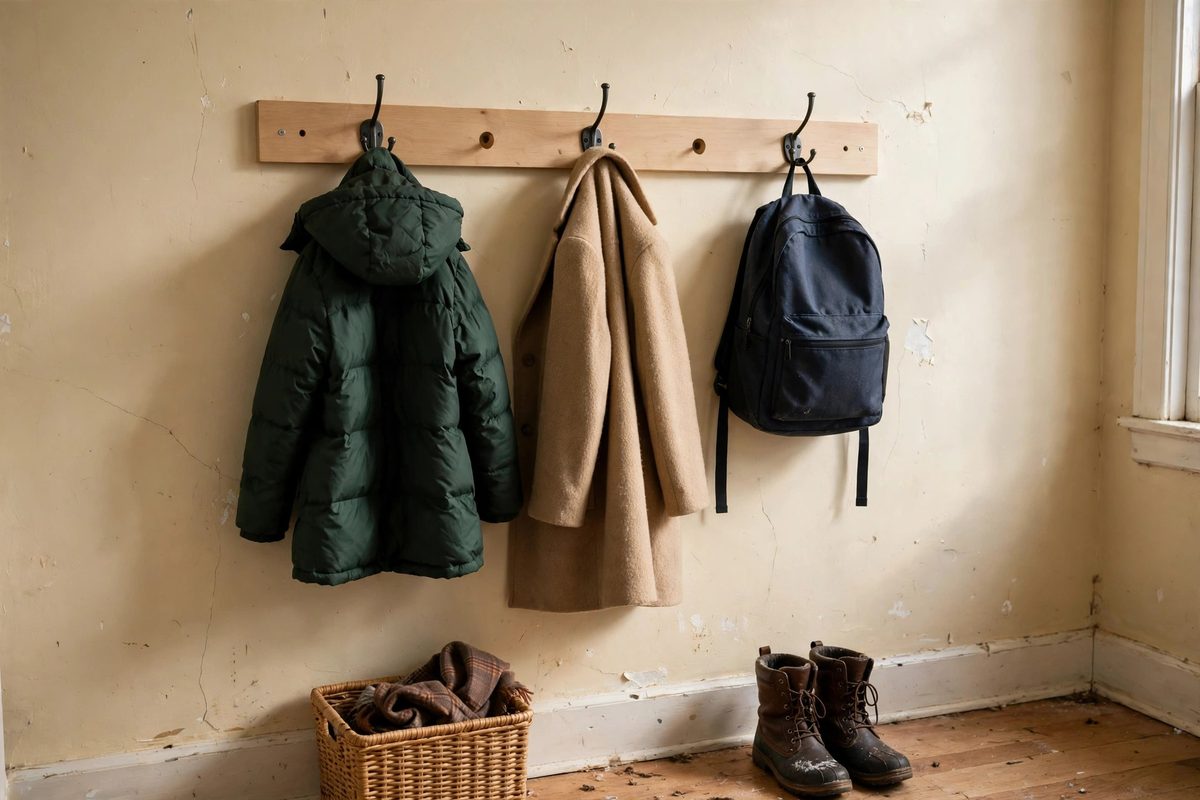
Hooks fail for two reasons: there are too few of them, or they are too weak for the coats they hold. A mudroom needs one sturdy hook per person for the daily coat, plus one extra hook per person for a bag or a second layer. That is it. More hooks invite more coats, and more coats become a pile again.
Mount hooks into studs, not just drywall, especially for heavy winter coats and full backpacks. Double hooks, one high and one low on the same mount, work well for adults and children sharing a wall. Keep a strict rule for the hooks: if a coat has not been worn in two weeks, it moves to the closet. The mudroom holds the coats in use right now, not the whole wardrobe. Closet overflow belongs in the closet, and our Bedroom Organization Ideas guide covers keeping that closet honest.
Boot trays and a drying zone for wet gear
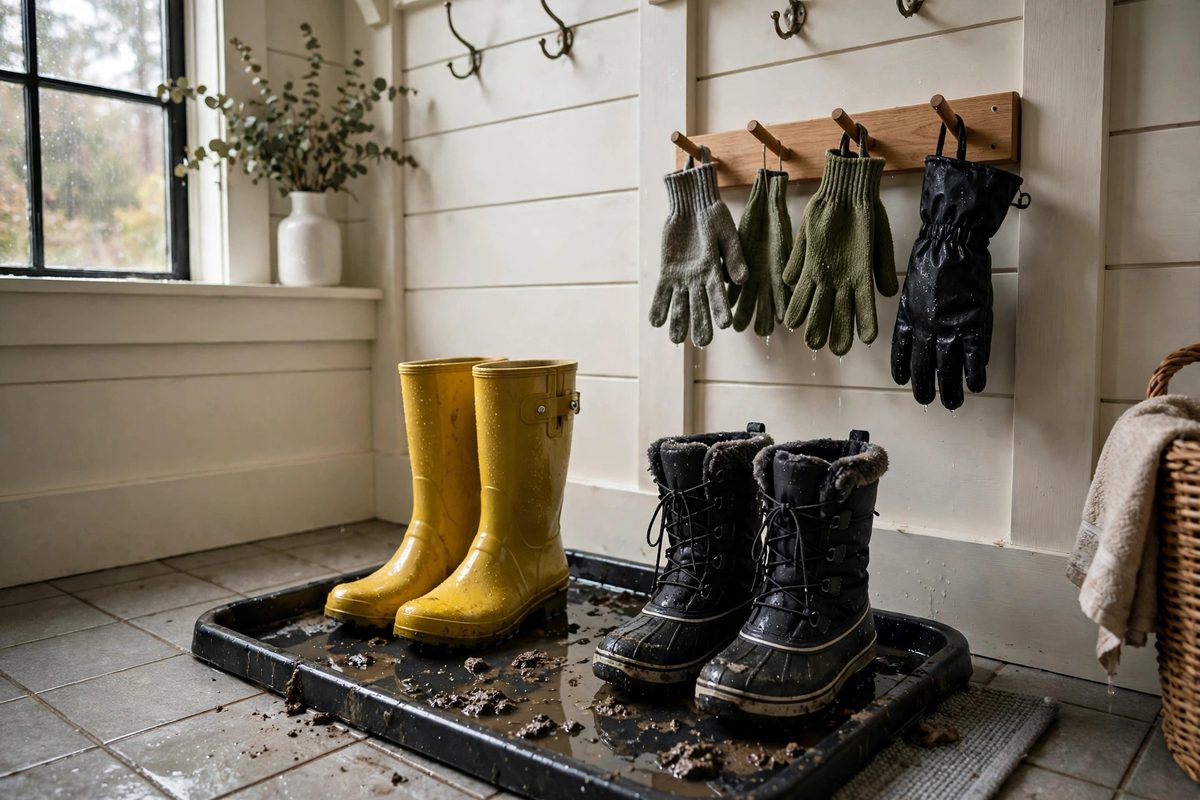
Wet boots are what turn a mudroom from tidy to miserable. Without a place for them, mud and water spread across the floor, and the next person through tracks it into the house. A boot tray solves most of it for very little money.
Place a shallow tray with a raised edge under the hooks, one tray per person or one long tray for the whole family. Boots go on the tray, not beside it, and the tray gets emptied and wiped once a week. Add a drying zone for the things that cannot go straight into a basket: wet gloves, damp hats, and rain gear. A small wall-mounted drying rack or a few pegs near a vent lets wet things dry before they are stored, which keeps the mudroom from smelling like a wet dog. The same drying logic we used for damp laundry in our Laundry Room Organization Ideas guide applies here. Wet things dry first, then they get stored.
One basket per person
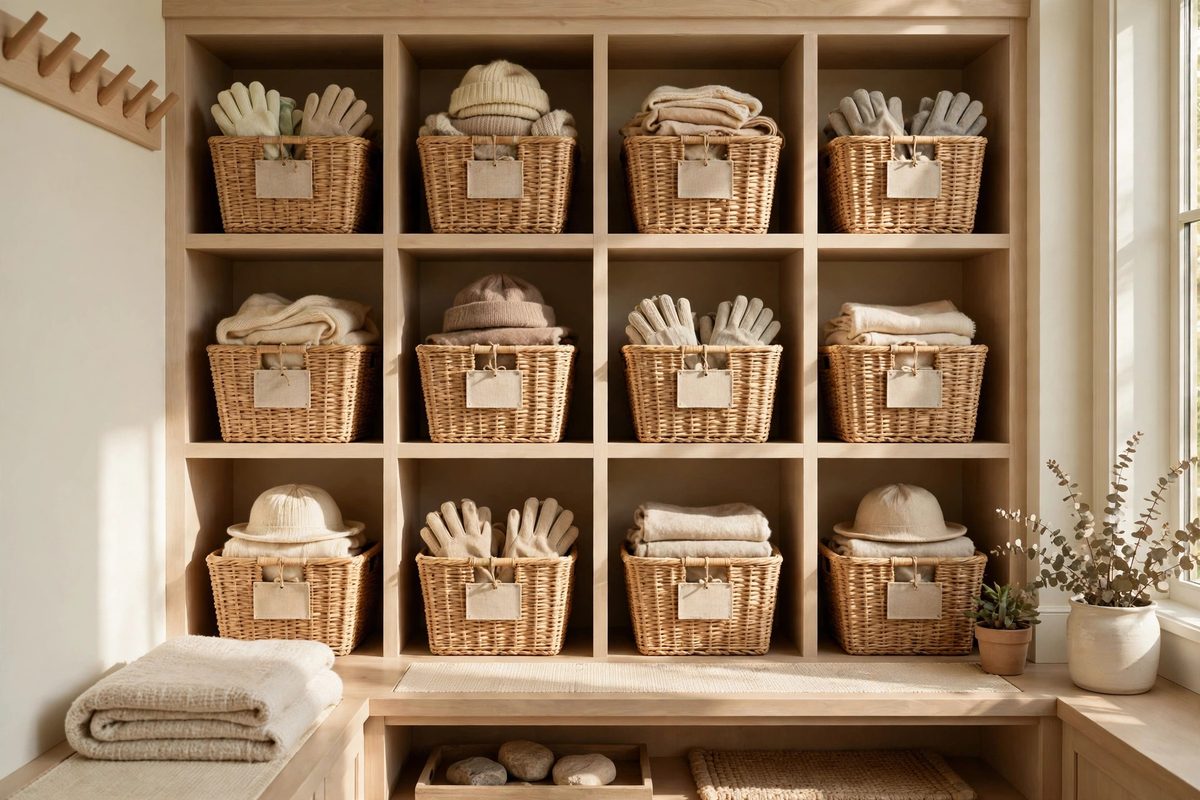
Small things are what defeat a mudroom. Gloves, hats, scarves, sunglasses, sunscreen, the dog leash, the reusable bags. None of them has a natural hook, so they end up on the bench, on the floor, or in a junk drawer that nobody can find.
Give each person one basket, sized for their small things and no bigger. A basket that is too big becomes a junk bin. Label it with the person’s name and keep it in their cubby or on their shelf. When the basket is full, something comes out before anything new goes in. Keep one shared basket too, for the things the whole household uses: the dog leash, the reusable shopping bags, and the umbrella stand. Shared things get one home, not three.
Backpacks, bags, and sports gear
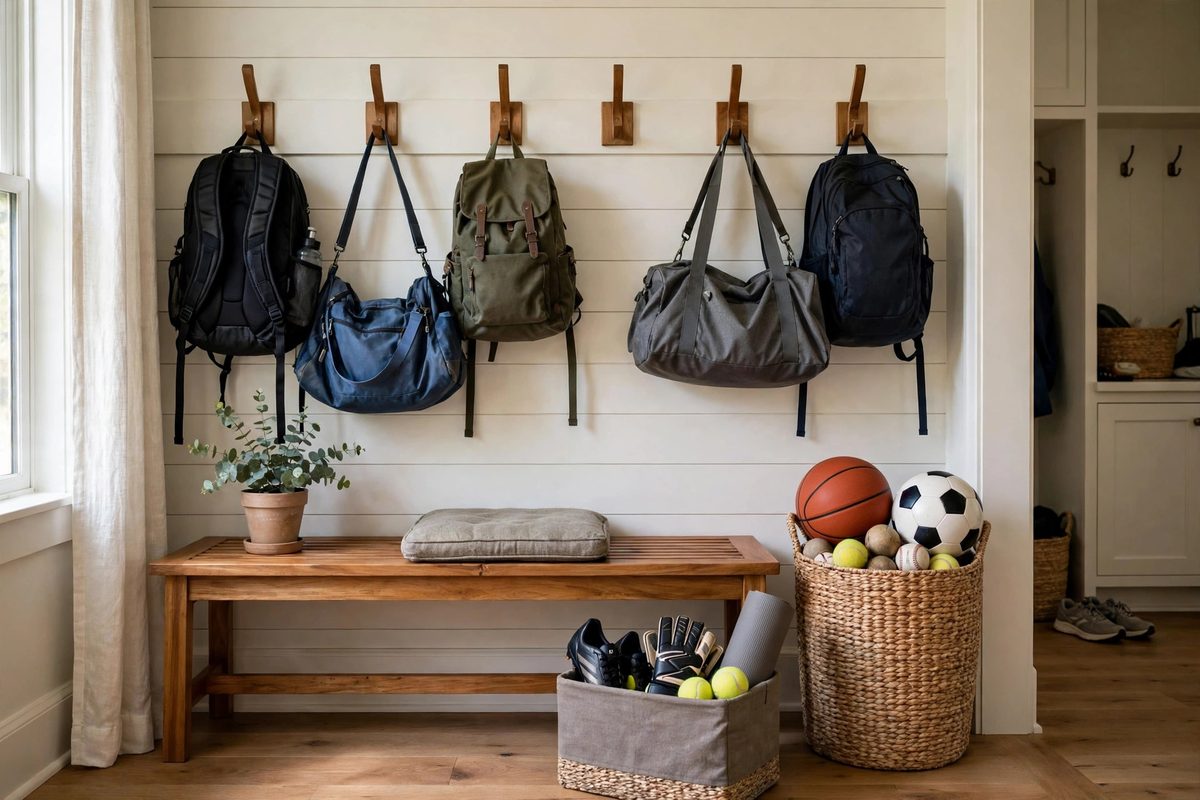
Bags are the bulkiest thing in a mudroom, and they are the first thing to slide off a hook and onto the floor. A backpack needs a hook rated for its weight, hung low enough that a child can lift it on and off without a struggle, and a rule that it gets emptied every Friday. A bag that never gets emptied becomes a second closet.
Sports gear needs its own spot, separate from daily bags. One bin or basket per sport, labeled, holds cleats, shin guards, and practice gear so a soccer bag does not mix with the swim bag. Keep balls in a tall bin or a net, not loose on the floor. For gear used once a week, a high shelf works. For gear used daily, keep it at hook height. The same one-bin-per-activity rule we used for seasonal gear in our Garage Organization Ideas guide applies here, just at mudroom scale.
Small mudrooms and hallway nooks
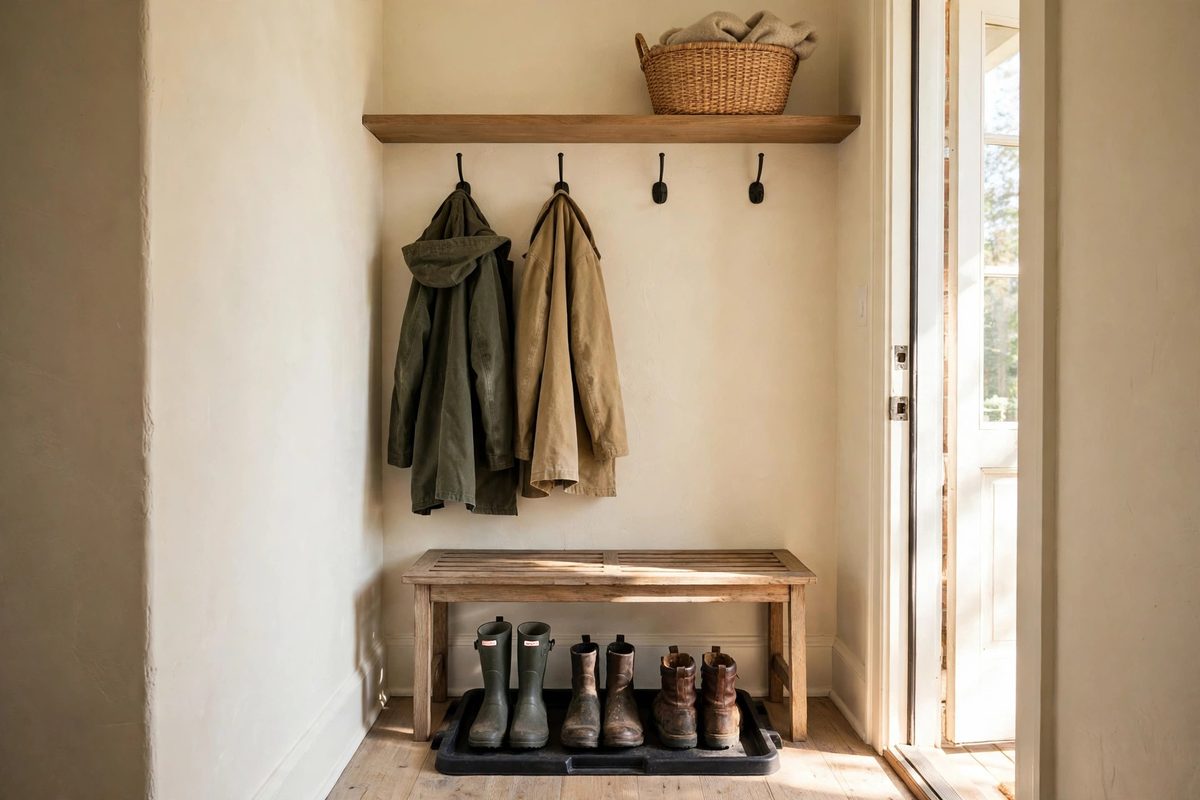
Most homes do not have a dedicated mudroom, and that is fine. A hallway nook with a bench and a row of hooks does the same job, as long as it is honest about its size. If a bench, four hooks, and a boot tray share a hallway, there is no room for a full shelving wall and a pile of seasonal bins, and pretending otherwise only creates a new obstacle.
Go vertical before you go wider. A row of hooks and one shelf above them hold more than a floor unit in the same footprint. Keep the walking path clear first, then add storage around it, not in it. Use a narrow bench, or a wall-mounted folding bench, if floor space is tight. Keep one rule that saves small mudrooms: if new gear comes in, old gear leaves, goes up high, or gets donated. A small mudroom works when every item earns its spot every week.
Budget mudroom organization
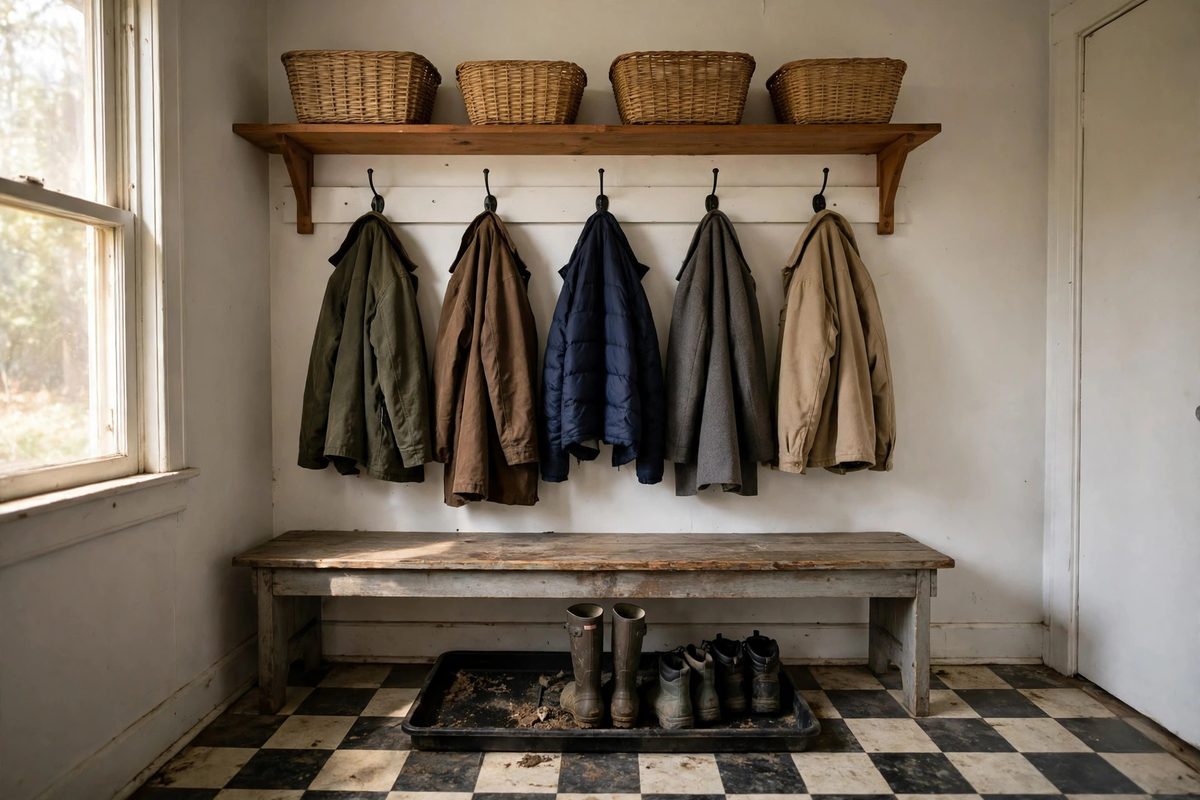
You do not need built-in lockers or a renovated mudroom to fix the space. Some of the most usable mudrooms I have seen cost less than a pair of winter boots. A secondhand bench, a few sturdy hooks, and labeled baskets will do more than an expensive built-in that nobody maintains.
Spend money only where it changes daily life. Sturdy hooks mounted into studs are worth paying for, because a hook that pulls out of drywall helps nobody. So is a bench that can hold the weight of a person sitting on it while they pull on boots. Everything else can be simple, as long as it is easy to reach and easy to put back.
Which mudroom storage fits your mudroom?
| Piece | Best for | Typical cost | Watch out for |
|---|---|---|---|
| Wall hooks or peg rail | Daily coats and bags | $15-$60 | Mount into studs, check weight limits |
| Bench with shoe cubbies | Sitting, shoes, and bags | $80-$300 | Leave the seat mostly clear |
| Boot tray | Wet boots and mud control | $15-$40 | Empty and wipe weekly |
| Labeled baskets | Gloves, hats, and small gear | $8-$25 each | One per person, not one giant bin |
| Cubby or locker unit | Per-person zones for families | $150-$500 | Measure the wall before you buy |
Quick pick guide:
- You have a full mudroom: per-person cubbies, a bench with shoe storage, boot trays, and one basket per person. That quartet covers coats, shoes, wet gear, and small things.
- You have a hallway nook: a narrow bench, one row of sturdy hooks, and a boot tray. Nothing on the floor that blocks the walking path.
- You rent and cannot drill much: a freestanding bench with cubbies, over-door hooks, and a boot tray. Everything leaves with you when you move.
- You have young kids: low hooks they can reach, labeled baskets with photos, and a boot tray per child. The system works only if kids can use it alone.
The seasonal rotation and mistakes to avoid
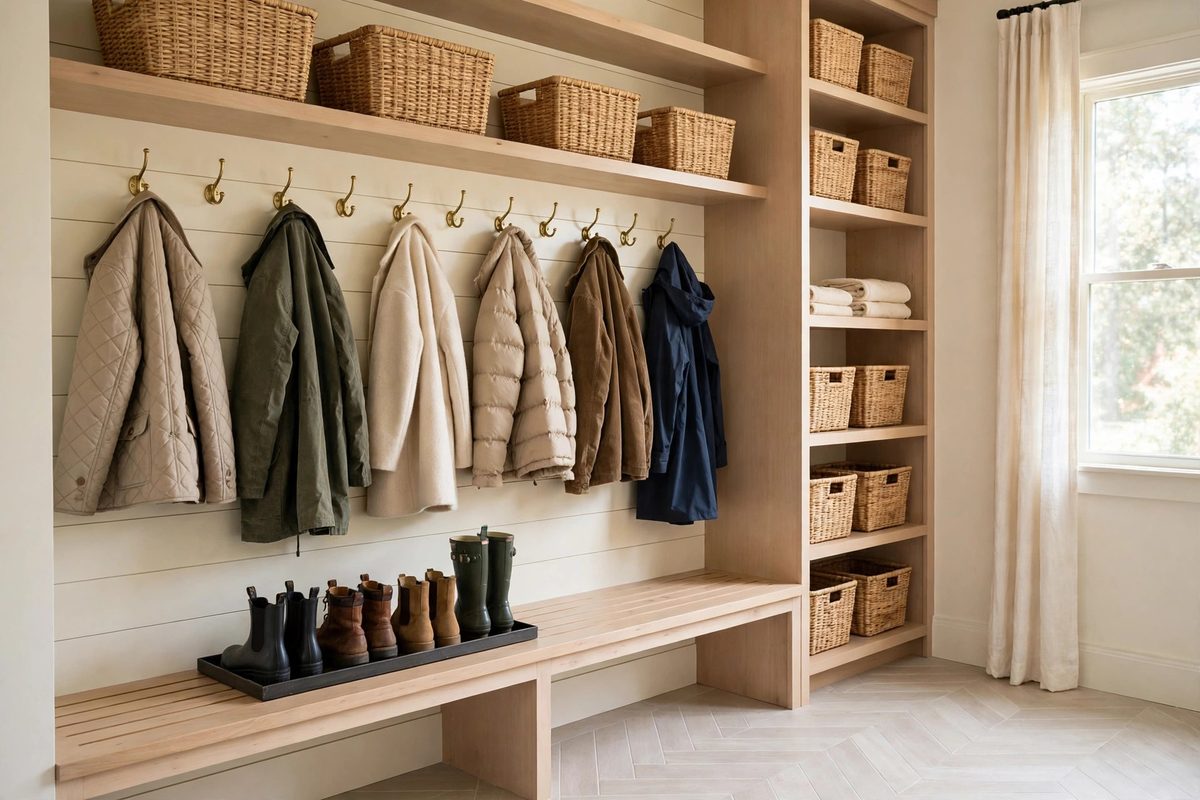
A mudroom does not stay tidy on its own. It stays tidy because someone resets it, briefly and often. The reset takes twenty minutes at each season change, plus a five minute tidy at the end of the week. Put coats back on hooks. Return shoes to cubbies. Empty the baskets. Wipe the boot trays. Move out-of-season gear to its storage spot, and bring the new season’s gear down.
Fall is the big rotation. Summer hats and sandals go up high or into storage, and winter coats, boots, gloves, and scarves take their hooks. Do it before the first cold snap, not after, so the mudroom is ready when the weather turns. The same seasonal swap thinking we used for the garage applies here. One rotation, done on time, prevents the slow pile-up that fills most mudrooms by December.
Mistakes to avoid:
- Buying storage before the edit. You will buy the wrong size and fill it with gear you do not use.
- One big pile for all coats. Shared hooks become a tangle within a week.
- No boot tray. Mud and water spread, and the next person tracks it inside.
- Baskets that are too big. An oversized basket becomes a junk bin.
- Storing wet gear in a closed basket. Wet things smell, and they stay wet.
- Skipping the seasonal rotation. Gear that stays out all year slowly takes the whole mudroom.
Frequently asked questions
Q: How do I organize a mudroom on a budget?
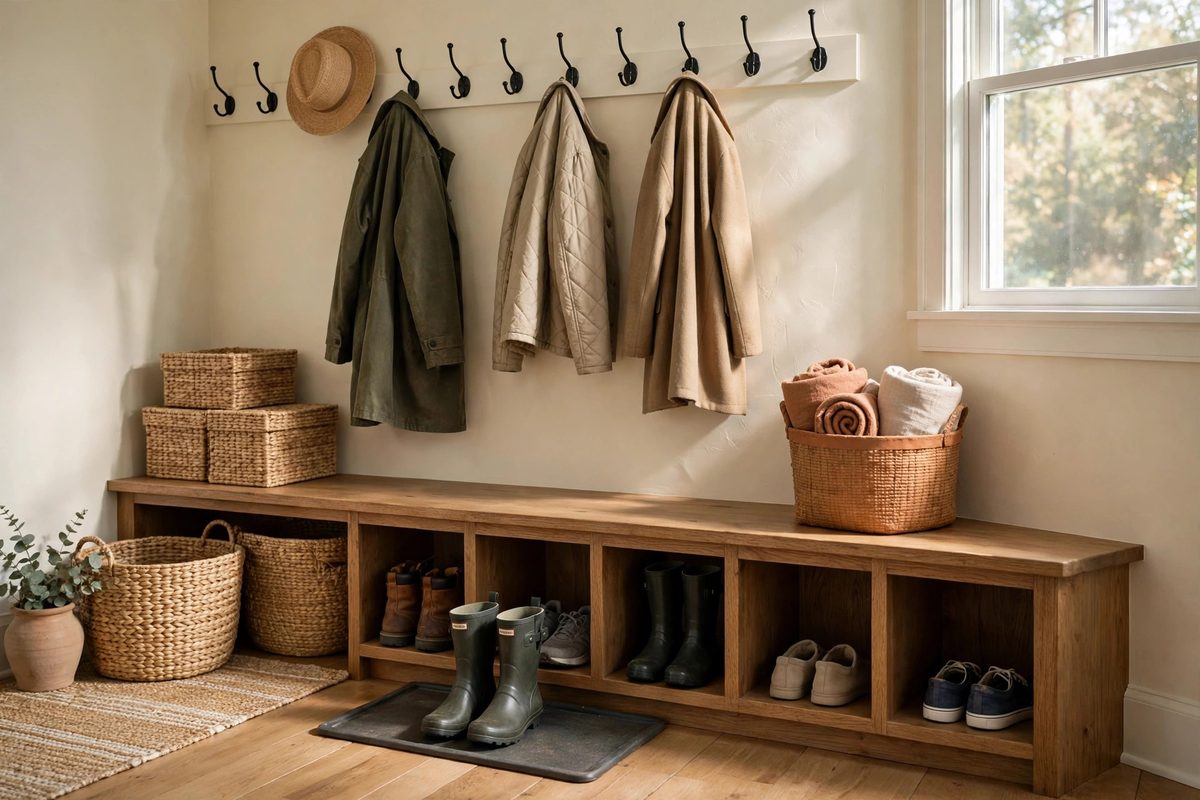
A: Start with the edit, then add one row of sturdy hooks mounted into studs, a bench with shoe cubbies, a boot tray, and one labeled basket per person. Spend on safe mounting first, and keep the rest simple.
Q: How do I organize a small mudroom?
A: Go vertical. One row of hooks, one shelf above them, a narrow bench, and a boot tray. Keep the walking path clear first, and give every item one home that earns its spot each week.
Q: How many hooks does a mudroom need?
A: One sturdy hook per person for the daily coat, plus one extra per person for a bag or a second layer. More hooks invite more coats, and the mudroom fills up again.
Q: How do I keep mud out of the house?
A: Use a boot tray under the hooks, keep shoes in cubbies instead of on the floor, and wipe the tray once a week. A doormat outside the door catches the worst of it before it reaches the mudroom.
Q: How often should I declutter the mudroom?
A: Do a five minute tidy at the end of each week and a twenty minute seasonal rotation four times a year. A full edit once a year is enough to catch outgrown boots, unworn coats, and baskets that no longer match their labels.
A good mudroom does not ask much of you. It asks for one hook per person, a place for wet boots, a basket for small things, and twenty minutes at each season change to put things back. Start with the edit, zone the room by person, and let the storage follow the gear you actually own. The pile by the door will still try to come back, because every home has one, but it will have nowhere to settle if every hook, cubby, and basket already has a job.
If you want to learn more about how we think about calm, practical systems for real homes, read About Declutter Joy.